显示标签为“stainless steel coils”的博文。显示所有博文

2016年6月27日星期一

[ Wiki ]Metallography of Stainless Steels

INTRODUCTION

Stainless steels are referred to corrosion-resistant steels that consist of up to 11% chromium. This set of high alloy steels are further divided into four categories; austenitic, martensitic, ferritic, and austenitic-ferritic (duplex) stainless steels (Figure 1). These categories describe the microstructure of an alloy at room temperature, which is considerably affected by the composition of the alloy.
Figure 1. Duplex steel etched electrolytically with 150x40% aqueous sodium hydroxide solution, showing blue austenite and yellow ferrite.
Corrosion resistance is the main property of stainless steels, and this feature can be further improved by adding certain alloying elements. Such elements impart positive effect on other properties, like oxidation resistance and toughness.
Titanium and niobium, for example, boost resistance against inter-granular corrosion as they take in the carbon element to produce carbides; nitrogen to increase strength, and sulfur to increase machinability because it form tiny manganese sulfides that lead to short machining chips. Stainless steels have excellent surface finishes and corrosion resistance, so they play a major role in the medical, aircraft, food and chemical industries, in architecture, professional kitchens, and jewelry.
Metallography of stainless steels is an important part of the overall quality control of the production process. The important metallographic tests are as follows:
  • Detection of delta ferrite and sigma phase
  • Measurement of grain size
  • Assessment and distribution of carbides
In addition to this, metallography is also utilized in failure analysis of oxidation and corrosionmechanisms.

DIFFICULTIES DURING METALLOGRAPHIC PREPARATION

Grinding and Polishing

This involves the deformation and scratching of austenitic and ferritic stainless steels (Figure 2); inclusions and carbides are retained.

Figure 2. Austenitic steel, color etched (Beraha II).

Solution

Alumina or colloidal silica can be used for systematic diamond polishing and final polishing.

PRODUCTION AND APPLICATION OF STAINLESS STEEL

High alloy steels are produced by melting and remelting processes, which are highly advanced procedures. In an electric arc furnace, a combination of well sorted scrap and iron is initially melted and continuously cast into billet or bloom, or cast into ingot form. These main products can be additionally processed into rod, bar, or plate shapes in a large number of applications. For higher quality steels, the main product can be utilized as feedstock for a secondary process of steelmaking. This process can be remelted twice or even three times by vacuum induction melting and electroslag remelting or vacuum arc remelting, which can be carried out under protective and pressure gases.
The secondary process is usually done to reduce impurities like silicates, sulphides, and oxides, so that with repeated remelts the level of cleanliness increases, producing uniform ingots with excellent physical and mechanical properties.

Application

Stainless steels’ high corrosion resistance depends on the creation of a passive surface oxide layer that spontaneously rebuilds itself when it is damaged mechanically, and is also based on alloying iron with chromium. Stress, pitting, intercrystalline, and vibrational corrosion are different types of corrosion that can occur. If alloying elements other than chromium are added, better resistance against certain forms of attack can be obtained. Molybdenum, for example, enhances resistance against pitting corrosion. Here the primary alloys, properties, and the associated applications of four forms of stainless steels are elucidated.
Ferritic stainless steels have a low carbon content, with 11 to 17% of chromium, and they are non heat treatable alloys. Properties of ferritic stainless steels include moderate strength and toughness, magnetic property, and resistance to atmospheric corrosion. Applications include car trim, razor blades, and magnetic valves.
Martensitic stainless steels have a medium carbon content, with up to 12 to 18% of chromium and 2 to 4% of nickel. They are heat treatable alloys. Properties include high creep resistance, high temperature resistance, and high corrosion resistance. Applications include knives, scalpels, tweezers and hooks in medical applications, high performance parts and drive systems for aircraft.
Austenitic stainless steels have 0.03 to 0.05% of carbon and their main alloying elements are molybdenum (2-4%); nickel (8-25%), and chromium (17-24 %). Niobium and titanium are added for carbide forming. Austenitic stainless steels are not heat treatable. Properties include high corrosion resistance, high ductility, good cold forming properties, resistant to oxidizing acids and alkalis, and easy to work and machine. Applications include implants, bolts, and screws; low temperature applications comprise pipes and vessels and pipes in the food, chemical, and pharmaceutical industries, and kitchen utensils.
Austenitic-ferritic steels (Duplex) have lower nickel content (4-6%) and higher chromium (21-24%). They have 2 to 3% of molybdenum and exhibit a low carbon content. Properties include excellent resistance from stress corrosion, and fatigue resistance in corrosive media. Applications include architecture, equipment for environmental, chemical, and offshore industries.

Difficulties in the Preparation of Stainless Steels

Austenitic steels are ductile and ferritic stainless steels are soft, and both are inclined to mechanical deformation. These steels become highly reflective when subjected to final polishing, but if they are not fully pre-polished, deformation will reappear following etching (Figure 3). Martensitic steels have excellent hardness, and can be easily polished. However, carbides should be preserved properly.
Figure 3. Austenitic steel insufficiently polished 500x showing deformation after etching (Beraha II).

RECOMMENDATIONS FOR THE PREPARATION OF STAINLESS STEELS

High pressures and highly coarse grinding papers or foil should not be used for soft and ductile stainless steels, as this can lead to deep deformation. Generally, the finest possible grit, which is uniform with the surface roughness and sample area, must be utilized for plane grinding. Diamond on a rigid disc, such as MD-Largo, is used to perform fine grinding, or on a MD-Plan cloth as an alternative to certain types of stainless steels. After fine grinding, a complete diamond polish is done on a medium soft cloth. This is followed by a final polish using alumina (OP-A) or colloidal silica (OP-S) for scratch removal. This particular step should be done meticulously and will take several minutes. A better contrast can be obtained through a good final polish. Fine grinding and even final polishing will not remove deformations occurring from the initial grinding step. Such deformations will leave some traces.
A preparation method for stainless steel samples is shown in Table 1, and a preparation method for 6 stainless steel samples is illustrated in Table 2.
Table 1. Preparation method for stainless steel samples, 30 mm diameter mounted, on the semi-automatic Tegramin, 300 mm diameter
Table 2. Preparation method for stainless steel samples, 65x30 mm, cold mounted or unmounted using Struers MAPS or AbraPlan/AbraPol, 350 mm diameter

ELECTROLYTIC POLISHING

When it comes to rapid general structure check and research analysis, electrolytical polishingand etching provides an alternative option to mechanical polishing of stainless steels, because this process does not leave mechanical deformations. However, while electrolytical polishing does provide good result for investigating the microstructure (Figure 4), it is not suitable for detecting carbides, which appear either enlarged or washed out.
Figure 4. Stainless steel weld, polished and etched electrolytically, DIC
The samples need to be ground to 1000# on silicon carbide paper or foil prior to electrolytical polishing. If the initial surface is finer, better electrolytical polish can be obtained. Preparation method is as follows:
  • Electrolyte: A3
  • Flowrate: 13
  • Area: 1 cm²
  • Voltage: 35 V
  • Time: 25 seconds
External etching with stainless steel etching dish
  • Voltage: 15 V
  • 10% aqueous oxalic acid
  • Time: 60 seconds

ETCHING

Some amount of expertise and patience is required to etch stainless steels. Extensive literature is available for etchants, and it is suggested to test out various etchants to set up a separate stock of solutions that are suitable for a certain material prepared in the lab on a regular basis.
Stainless steels have excellent resistance against corrosion, so very strong acids are needed to expose their structure. When handling these etchants, standard safety precautions should be followed. In most labs, the etchants specified in the literature will be altered based on personal preference or the material that is being etched. Adequate final oxide polishing is required to obtain good etching results. Some etchants are effective in routine applications, and they are as follows:
Chemical etching
  • For martensitic steels - 25g picric acid, 925 ml ethanol, 50 ml hydrochloric acid.
  • For austenitic steels - Swab etch: 500 ml distilled water, 300 ml hydrochloric acid, 200 ml nitric acid, 50 ml of a saturated iron-III-chloride solution, 2.5g copper-II-chloride, 300 ml hydrochloric acid, 100 ml water, 15 ml hydrogen peroxide (30%); V2A etchant: 100 ml hydrochloric acid, 100 ml water, 10 ml nitric acid, etch at room temperature or up to 50°C temperature.
  • Color etchant Beraha II: Stock solution, 800 ml distilled water, 400 ml hydrochloric acid, 48g ammonium biflouride; to 100 ml of this stock solution 1 to 2g of potassium metabisulfite should be added for etching.
Electrolytic etching
  • All stainless steels: 10% aqueous oxalic acid
  • For austenitic-ferritic steels (Duplex) - 40% aqueous sodium hydroxide solution
The proposed safety precautions should be followed when handling chemical reagents.

STRUCTURE INTERPRETATION

Heat treatment has no effect on ferritic stainless steels, but the properties of these steels can be affected by cold working. At room temperature, ferritic stainless steels are magnetic. In annealed condition, the microstructure includes ferrite grains, wherefine carbides are integrated. Ferritic steels employed for machining purposes include a considerable amount of manganese sulfides to enable free cutting, as shown in Figure 5.
Figure 5. Ferritic stainless steel with manganese 200x sulfides and strings of small carbides, etched electrolytically with 10% oxalic acid.
Heat treatment has a major effect on martensitic stainless steels, which are formed via instant cooling. Tempering treatment can be used to optimize their properties. The alloys of martensitic stainless steels are magnetic in nature. The microstructure can range from pure martensitic structure, through to fine tempered martensite based on the thermal treatment. Complicated heat treatment temperatures are required for different alloys and different sizes of semi-finished products. An often unwanted phase is delta ferrite (Figure 6), because extended annealing times of steels with high chromium content at 700 to 950°C can alter the delta ferrite into a brittle and hard iron-chromium intermetallic sigma phase.
Figure 6. Tempered martensitic stainless 75xsteel with delta ferrite, etched with picric acid.
The sigma phase and the embrittlement are removed by heating to a temperature of 1050°C. Thermal treatment has no effect on austenitic stainless steels, but quick cooling leads to the formation of their softest condition. Austenitic stainless steels are non-magnetic in this state, and their properties are affected by cold working. The steels’ microstructure includes austenite grains that may display twinning (Figure 7).
Figure 7. Cold worked austenitic steel showing twinning, etched with V2A etchant.
When these steels are exposed to increased temperatures of 600 to 700°C, complex carbides are formed inside the austenite grains. This results in an insolvency of chromium in the austenite solid solution, increasing the sensitivity to inter-granular oxidation or corrosion. The risk of inter-granular corrosion can be minimized by reducing the carbon content to less than 0.015% and introducing minute quantities of niobium or titanium. This is because these elements form carbides rather than the chrome (Figure 8). Delta ferrite can be a result of the cold working of austenitic steels or heat treatment conditions in martensitic steels (Figure 9).
Figure 8. Austenite with carbides and some 200x titanium carbon nitrides.
Figure 9. Austenitic steel with strings of delta 125xferrite, showing microsegregations. Blue areas: depletion of alloying elements.
Austenite and ferrite are present in austenitic-ferritic stainless steels (Duplex). The structure is revealed through electrolytic etching in a 40% caustic soda solution, and this helps to estimate the right percentage of individual phases (Figure 10). These steels are ductile and are mainly utilized in the paper, food, and petroleum sectors.
Figure 10. Forged duplex steel showing blue ferrite, white austenite and fine needles of sigma phase, etched electrolytically with 40% aqueous sodium hydroxide.

CONCLUSION

Corrosion resistant steels are referred to as stainless steels, which contain high contents of nickel and chromium. Stainless and ferritic steels are soft, ductile, and inclined to scratching and mechanical deformation during the course of metallographic preparation. Moreover, carbides cannot be retained often. To ensure an effective mechanical polish, the following things should be considered.
  • Fine grinding and polishing with diamond must be meticulous, and all deformation should be removed from plane grinding.
  • Coarse abrasives for plane grinding should not be used
  • A final oxide polish with alumina or colloidal silica should be done to provide a surface that is free from deformation.
A four step process carried out on an automatic preparation system provides good and reproducible results. Chemical etching of stainless steels can be difficult, and the proposed etchants are corrosive and have to be handled carefully. Another option is to use electrolytical polishing and etching, which does not retain carbides, but provides a deformation-free surface.

[ News ]Steel scrap: A world-traded commodity


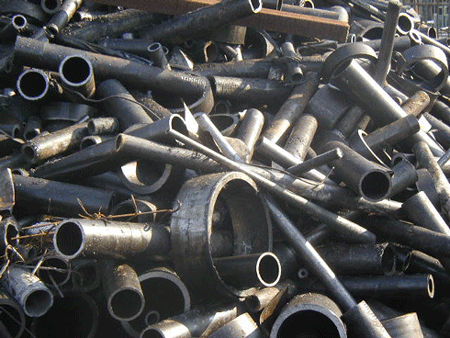
To most, the word ‘scrap’ evokes visions of unwanted, discarded leftovers. However, to the steel industry, scrap represents a vital resource that enhances all aspects of steelmaking.
The recycling of scrap metal is an integral part of modern steelmaking, improving the industry's economic viability and reducing environmental impact. The recycling of steel scrap reduces the need for iron ore extraction, significantly reducing CO2 emissions, energy and water consumption and air pollution.
As a result of these efficiencies, steel scrap is increasingly being regarded as a raw material for manufacturing new products worldwide. Ferrous scrap – iron and steel – has become a globally traded commodity. The increased demand for steel scrap is reflected in recent trade statistics.
The United Nations Commodity Trade Statistics Database shows that the volume of global scrap exports increased from 9.3 million tonnes in 1990 to 106 million tonnes in 2011. Figures from the Bureau of International Recycling show that total world steel scrap use increased 7.6% in 2011 to reach 570 million tonnes.
The globalization of the ferrous scrap market, however, also places stresses on the system. The long lifespan of steel products means that the amount of steel available for recycling cannot keep up with the current world demand for new steel products. With steel, structures can last longer than 60 years and cars often last longer than 12 years; steel products can be seen as scrap-in-inventory – meaning that the steel will not be ready for recycling until the long life of the product comes to an end.
A positive aspect of steel is the ease of recycling when products finally do reach the end of their life. The ability to recover and collect old steel products for subsequent recycling is greatly enhanced by the inherent magnetic properties of steel; consequently, a large tonnage of steel becomes available for recycling every year.
Figures from the US Census Bureau and the US International Trade Commission demonstrate that the US is the world’s largest exporter of ferrous scrap – exporting nearly 23 million tonnes of iron and steel scrap in 2011. Globally, China, Taiwan, South Korea, India, Canada, and Turkey are the largest markets for exports of US steel scrap in that same period.
Ferrous scrap exports from the EU to third countries reached a record high in 2012. The 27 member states exported around 19.22 million tonnes of iron and steel wastes and scrap valued at €6.8 billion to countries outside the Union (extra-EU trade), according to preliminary figures released by the European Statistical Office, Eurostat. The export volume exceeded the 2011 amount of 18.81 million tonnes by 407,000 tonnes or 2.2%. The UK was by far the largest exporter of the EU-27, shipping nearly 5.2 million tonnes of ferrous scrap outside the EU. The most important destination country for EU ferrous scrap was Turkey. At 11.05 million tonnes and a value of €3.3bn, around 58% of all extra-EU ferrous scrap exports headed to this country (2011: 9.97 million tonnes, €3.1bn).
North America is also one of the largest consumers of its own steel scrap – recycling more than 70% of that scrap domestically, with mini-mills being the primary source of recycled steel. Mini-mills use electric arc furnaces, which melt scrap metal via the heat produced by an electric arc. US producers Nucor (one of the world's largest steel producers), as well as one of its competitors, Commercial Metals Company (CMC) use mini-mills exclusively. Since the electric arc furnace can be easily started and stopped on a regular basis, mini-mills can follow the market demand for their products easily, operating on 24 hour schedules when demand is high and cutting back production when sales are lower.
“This high level of scrap consumption is a reflection of the steel industry’s commitment to conserving energy and natural resources,” said Gregory Crawford, executive director of the Steel Recycling Institute in North America. “Scrap steel is used in everyday products, including packaging, appliances, automobiles and construction. Each year, more steel is recycled in North America than paper, aluminum, plastic and glass combined.”
This flow of scrap also faces challenges in the form of trade restrictions. The Organization for Economic Cooperation and Development (OECD) reported in 2012 that North American and European ferrous scrap is traded openly, but that about 19 percent of the scrap trade is burdened by various trade restrictions.
The 2012 OECD report noted that “waste and scrap exports are restricted in many parts of the world. Waste and scrap trade involving iron and steel and non-ferrous base metals (copper, aluminum, lead and zinc) tends to be more regulated than trade involving other metals.”
The OECD found that, in 2009, at least 19% of scrap of iron and steel, exported by a total of 34 countries, was subject to export restrictions. “Export restrictions dampen trade flows,” stated the report. “In fact, some exports actually will not take place due to the very fact that export restrictions are in place. Export activity would be higher if restrictions did not exist.”
The rationales that governments cite most frequently as motivating their use of the restrictions include safeguarding domestic supplies, controlling illegal exports, and protecting local industry. Non-automatic export licensing, export taxes and other export prohibitions were among the measures used to regulate the export of iron and steel scrap, according to the OECD.

[ News ]Building sustainable benefit with steel construction


Even during periods of economic turmoil, the environment remains a key issue for our world.
By 2050, it is estimated that there will be two billion more people living in the world’s cities which, according to experts, will mean that world construction will grow by more than 70% and reach $15 trillion by 2025, outpacing global GDP. Part of the solution is to build with steel – 50% of steel is used in construction. With four people per house, this will mean providing 1,427 homes every hour, with most of them needed in Asia and Africa. How can such growth be made sustainable?
As most people are aware, steel is used in so many important applications, from bridges and other large constructions, trains and rail lines to industrial machinery, housing, offices, hospitals, cars, buses and bicycles, to name but a few examples. Steel delivers a number of unique environmental benefits, such as product longevity, recyclability, easy transportation and less raw material wastage. In addition, steel offers architectural and design flexibility due to its inherent strength, which allows large span distances and curves to be easily incorporated into designs.
Perhaps best of all, steel is 100% recyclable, without losing any of its properties or strength, and thus reducing the solid waste stream, which results in saved landfill space and the conservation of natural resources. Indeed, more steel is recycled each day than any other material. Even better, the steel industry as a whole has dramatically improved its energy efficiency over the past 30 years, cutting energy consumption by 50% per tonne of steel produced and substantially reducing carbon dioxide (CO2) emissions, also per tonne of steel.
The industry is always looking for ways to improve, and to that end a project is in place in the United States that explores the possibility of replacing carbon with hydrogen in blast furnaces. In addition, ULCOS, which stands for Ultra–Low Carbon Dioxide(CO2) Steelmaking, is a consortium of 48 European companies and organisations from 15 European countries that have launched a co-operative research and development initiative to enable drastic reduction in CO2 emissions from steel production. The consortium consists of all major EU steel companies, energy and engineering partners, research institutes and universities and is supported by the European Commission. The aim of the ULCOS programme is to reduce today’s CO2 emissions by at least 50%.
From a human health perspective, steel frames have proven ideal for the ‘healthy home’ concept. The incidence of asthma and sensitivity to chemicals is on the increase and steel frames have been used to achieve allergen-free and dust-free interiors. This requires techniques such as special sealing around windows, moisture barrier systems in the walls, extensive insulation, and whole house ventilation systems. Steel frames retain their original dimensions, which is a major factor in maintaining effective long-term sealing.
Steel is already being used to help manufacture lighter, more fuel-efficient vehicles as well as renewable energy infrastructure including wind turbines, solar installations, smart electric grids and energy-efficient housing and commercial buildings. Its economic benefits include its quick construction off-site, which means less site disturbance and waste, more usable floor space, e.g. thinner floors allowing for more stories in a building, the flexibility to re-configure buildings and steel has a long life with low maintenance, plus energy efficiency for lower operating costs.

#lovesteel: Steel in the home

This news is originally published in World Steel Asssociation.

worldsteel launched the start of phase two of its #lovesteel campaign titled ‘Steel in ...’. The campaign will develop into a series of interesting facts and intriguing images of steel use across different industries and describes how steel enriches modern living and enables us to have a more sustainable lifestyle.
The starting theme is ‘Steel in the Home’. The first infographic ‘Home, Steel, Home’ launched on 8 July , shows the widespread use of steel in our home environment and illustrates the value and benefits it brings in four key areas; sustainability, cost, safety, and design. Through a detailed cross-section the infographic highlights where steel is used in each part of the house and how it helps to make your home more sustainable.
Two upcoming infographics will present key statistics of steel use in the construction sector and the amazing architectural styles made possible by steel in residential housing. The first of these infographics was launched on 20 July and is published below.


[ Wiki ] Steel in Buildings and infrastructure


Construction is one of the most important steel-using industries, accounting for more than 50% of world steel production. Buildings - from houses to car-parks to schools and skyscrapers - rely on steel for their strength. Steel is also used on roofs and as cladding for exterior walls.
According to the UN's latest forecast dating July 2015, world population will reach 8.5 billion in 2030 and 9.7 billion in 20501..This will be accompanied by rapid urbanisation. As the need for buildings and infrastructure continues to grow worldwide, reducing consumption of natural resources and associated emissions is crucial for future sustainability.
Steelmakers around the world are increasingly providing construction solutions that enable energy-efficient and low-carbon-neutral buildings. These solutions reduce the environmental impact over the structures’ life cycle and help to extend their life span through design for disassembly and reuse.
Steel can provide the solutions to infrastructure and construction needs in developing countries and in climate resilient cities through enabling protective coastal and wind-resistant designs. While buildings currently account for about 20% of global greenhouse gas emissions, they also present many opportunities for reducing emissions and mitigating climate change.2,3
Not only is steel affordable, readily available and safer, its intrinsic properties, such as strength, versatility, durability and 100% recyclability allow for improved environmental performance across the entire life cycle of buildings. 
The advanced high-strength steels used in steel-plate applications also find uses in a number of related industries. Offshore oil rigs, bridges, civil engineering and construction machines, rail carriages, tanks and pressure vessels, nuclear, thermal and hydroelectric plants – all these applications benefit from the attributes of modern steels.
How steel is used in buildings and infrastructure
The possibilities for using steel in buildings and infrastructure are limitless. The most common applications are listed below4.

For buildings

  • Structural sections: these provide a strong, stiff frame for the building and make up 25% of the steel use in buildings.
  • Reinforcing bars: these add tensile strength and stiffness to concrete and make up 44% of steel use in buildings. Steel is used because it binds well to concrete, has a similar thermal expansion coefficient and is strong and relatively cost-effective. Reinforced concrete is also used to provide deep foundations and basements and is currently the world’s primary building material.
  • Sheet products: 31% is in sheet products such as roofing, purlins, internal walls, ceilings, cladding, and insulating panels for exterior walls.
  • Non-structural steel: steel is also found in many non-structural applications in buildings, such as heating and cooling equipment and interior ducting.
  • Internal fixtures and fittings such as rails, shelving and stairs are also made of steel. 

For infrastructure


MAKE A STAINLESS STEEL KITCHEN BACK-SPLASH

We often get asked what type of Stainless Steel Sheet can be used as a kitchen back-splash.
Stainless Steel 304 is the recommended grade. It should have a #4 brushed finish. The finish of this grade looks very similar to the type used for stainless kitchen appliances. This material can be cut to the size that you need, and can be adhered to the wall using construction adhesive.
This material comes with one-side brushed (#4 grit finish). It will have a peelable protective plastic layer that can be removed once the item has been installed. The reverse side is a plain matte finish, which can be used as the gluing surface.
You must consider the direction that you wish the brushed direction to go, before ordering your sizes. Make sure that you provide those details to one of our stores doing the cutting (or place in the comments section if ordering online). The brushed grain can either go along your length or across your width of the piece(s) that you need. A typical instruction to the store might be: “please cut with brushed grain along the 12 inch length”.
Stainless steel sheet comes in many thicknesses, from 0.125” (1/8”) thick to 0.030” (1/32”) thick. While each project may have a particular thickness in mind, the most commonly used thicknesses are 0.030” or 0.036” Thick. Please keep in mind that the thicker material will cost and weigh more.

INSTALLING STAINLESS STEEL BACK-SPLASH


  1. Make sure that the wall is flat. Remove all build up and repair any large dents.
  2. Test the placement of the sheet. Make a supporting cleat if the backsplash is not being supported by the counter top.
  3. Lay the sheet with the finished (#4) side down on a flat surface.
  4. Apply construction adhesive to the back side (using caulking gun), making sure that the lines of adhesive go back and forth across the entire sheet.
  5. Make sure that you evenly spread the adhesive on the sheet, using a putty knife.
  6. Place the stainless steel sheet against the wall with either the bottom resting against the cleat or the countertop. Once in place press the sheet against the wall.
  7. Using a soft cloth, move from side to side of the sheet, pressing firmly to remove any air bubbles that could be behind the sheet.
  8. Once the glue has dried and the project is complete, remove the protective layer.