THE KITCHEN SINK TAKES A LOT OF ABUSE. POTS AND PANS, DISHWARE AND SILVERWARE, ALONG WITH FOOD PREPARATION, ALL TAKE THEIR TOLL ON THE KITCHEN ESSENTIAL. AS THE CENTRAL FIXTURE IN THE KITCHEN, YOU WANT A SINK THAT CAN TAKE THE ABUSE AND STILL LOOK GOOD. ONE DURABLE CHOICE IS A STAINLESS STEEL SINK. BUT NOT ALL STAINLESS SINKS ARE CREATED EQUAL. TO EVALUATE A STAINLESS STEEL SINK, YOU NEED TO CONSIDER A FEW FACTORS IN ITS MAKEUP.
STEEL GAUGE
To ascertain the strength of the stainless steel, evaluate it based on its gauge. Stainless steel is a metal alloy used in a variety of applications, such as the construction of the Chrysler Building in New York. The thickness of stainless steel equates to its gauge, the number of layers that it takes to make 1 inch. For instance, 16-gauge stainless steel takes 16 layers of steel to make it an inch thick. The lower the gauge number, the thicker the steel, and the greater the sink can resist dents and scratches.
OXIDATION RESISTANCE
Oxidation leads to rust, but the chromium-to-nickel ratio in steel helps prevent it. So prior to purchase, check this ratio, as nickel gives the stainless steel strength and hardness, and chromium offers durability and shine. A typical chromium-to-nickel ratio uses 18 percent chromium and 10 percent nickel. It typically reads 18/10 on the sink's label.
FINISH TYPE
Stainless steel sinks come satin, polished, mirror or matte finishes. The type of finish you choose can be an asset or a liability in the kitchen. If you don't want to be constantly polishing the kitchen sink, avoid choosing a sink with a mirror or polish finish. These finishes show water spots and scratches. Instead, choose a sink with a matte or brushed finish that also provides resistance against scratches.
INSULATION
Some stainless steel sinks come without insulation. Without insulation, water heat escapes quickly, and the sounds are louder. Insulation helps to deaden the sound of water running in the kitchen. Check the type of insulation offered on the stainless steel sink. Foam insulation is of better quality and works more efficiently than sprayed-on insulation.
MOUNT TYPE AND SHAPE
Most kitchen sinks are available in differing mounting configurations. Some mount atop the counter and others underneath counters. Undermount units are best suited for solid surfaces such as stone or granite; they won't work with laminate materials. Choose a sink shape that matches your current sink or one that works well when remodeling.
BOWL DEPTH
Stainless steel sinks also come in multiple bowl depths. Some are shallow, while others offer a much deeper sink. Before buying your new stainless steel sink, verify it is deep enough to work with your cookware.
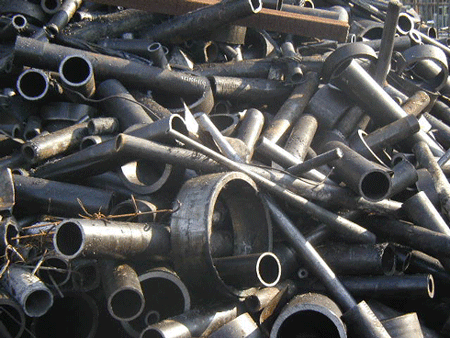
To most, the word ‘scrap’ evokes visions of unwanted, discarded leftovers. However, to the steel industry, scrap represents a vital resource that enhances all aspects of steelmaking.
The recycling of scrap metal is an integral part of modern steelmaking, improving the industry's economic viability and reducing environmental impact. The recycling of steel scrap reduces the need for iron ore extraction, significantly reducing CO2 emissions, energy and water consumption and air pollution.
As a result of these efficiencies, steel scrap is increasingly being regarded as a raw material for manufacturing new products worldwide. Ferrous scrap – iron and steel – has become a globally traded commodity. The increased demand for steel scrap is reflected in recent trade statistics.
The United Nations Commodity Trade Statistics Database shows that the volume of global scrap exports increased from 9.3 million tonnes in 1990 to 106 million tonnes in 2011. Figures from the Bureau of International Recycling show that total world steel scrap use increased 7.6% in 2011 to reach 570 million tonnes.
The globalization of the ferrous scrap market, however, also places stresses on the system. The long lifespan of steel products means that the amount of steel available for recycling cannot keep up with the current world demand for new steel products. With steel, structures can last longer than 60 years and cars often last longer than 12 years; steel products can be seen as scrap-in-inventory – meaning that the steel will not be ready for recycling until the long life of the product comes to an end.
A positive aspect of steel is the ease of recycling when products finally do reach the end of their life. The ability to recover and collect old steel products for subsequent recycling is greatly enhanced by the inherent magnetic properties of steel; consequently, a large tonnage of steel becomes available for recycling every year.
Figures from the US Census Bureau and the US International Trade Commission demonstrate that the US is the world’s largest exporter of ferrous scrap – exporting nearly 23 million tonnes of iron and steel scrap in 2011. Globally, China, Taiwan, South Korea, India, Canada, and Turkey are the largest markets for exports of US steel scrap in that same period.
Ferrous scrap exports from the EU to third countries reached a record high in 2012. The 27 member states exported around 19.22 million tonnes of iron and steel wastes and scrap valued at €6.8 billion to countries outside the Union (extra-EU trade), according to preliminary figures released by the European Statistical Office, Eurostat. The export volume exceeded the 2011 amount of 18.81 million tonnes by 407,000 tonnes or 2.2%. The UK was by far the largest exporter of the EU-27, shipping nearly 5.2 million tonnes of ferrous scrap outside the EU. The most important destination country for EU ferrous scrap was Turkey. At 11.05 million tonnes and a value of €3.3bn, around 58% of all extra-EU ferrous scrap exports headed to this country (2011: 9.97 million tonnes, €3.1bn).
North America is also one of the largest consumers of its own steel scrap – recycling more than 70% of that scrap domestically, with mini-mills being the primary source of recycled steel. Mini-mills use electric arc furnaces, which melt scrap metal via the heat produced by an electric arc. US producers Nucor (one of the world's largest steel producers), as well as one of its competitors, Commercial Metals Company (CMC) use mini-mills exclusively. Since the electric arc furnace can be easily started and stopped on a regular basis, mini-mills can follow the market demand for their products easily, operating on 24 hour schedules when demand is high and cutting back production when sales are lower.
“This high level of scrap consumption is a reflection of the steel industry’s commitment to conserving energy and natural resources,” said Gregory Crawford, executive director of the Steel Recycling Institute in North America. “Scrap steel is used in everyday products, including packaging, appliances, automobiles and construction. Each year, more steel is recycled in North America than paper, aluminum, plastic and glass combined.”
This flow of scrap also faces challenges in the form of trade restrictions. The Organization for Economic Cooperation and Development (OECD) reported in 2012 that North American and European ferrous scrap is traded openly, but that about 19 percent of the scrap trade is burdened by various trade restrictions.
The 2012 OECD report noted that “waste and scrap exports are restricted in many parts of the world. Waste and scrap trade involving iron and steel and non-ferrous base metals (copper, aluminum, lead and zinc) tends to be more regulated than trade involving other metals.”
The OECD found that, in 2009, at least 19% of scrap of iron and steel, exported by a total of 34 countries, was subject to export restrictions. “Export restrictions dampen trade flows,” stated the report. “In fact, some exports actually will not take place due to the very fact that export restrictions are in place. Export activity would be higher if restrictions did not exist.”
The rationales that governments cite most frequently as motivating their use of the restrictions include safeguarding domestic supplies, controlling illegal exports, and protecting local industry. Non-automatic export licensing, export taxes and other export prohibitions were among the measures used to regulate the export of iron and steel scrap, according to the OECD.
Perforated metal is a form of sheet metal which has been punched or stamped with a machine to create a pattern of holes. It is also known as perforated sheet, perforated plate, or perforated screen and is commonly made from stainless steel, cold rolled steel, aluminum and more.
Perforated metal was first developed around 150 years ago for the mining industry as a means of filtering coal. Initially, the perforation process was inefficient; involving laborers manually punching individual holes into a metal sheet. Over time, the process has improved through the use of machinery utilizing punching needles arranged in specific patterns.
HOW IS PERFORATED METAL MADE?
The manufacturing process for perforating metal starts with sheet metal. Sheet metal is thin and flat, and can be cut and bent into different shapes. In North America, the thickness of the sheet metal is specified in gauges; the larger the gauge number, the thinner the metal. In the rest of the world, sheet metal thickness is simply measured in millimeters.
The most common method of perforating metal uses a rotary pinned perforation roller. This is a large cylinder with sharp, pointed needles on the outside to punch holes into the metal. As the sheet metal is run across the perforation roller, it rotates, continuously punching holes in the passing sheet. The needles on the roller, which can produce a wide variety of hole sizes, are sometimes heated to simultaneously melt the metal which forms a reinforced ring around the perforation.
Another common method is “die and punch” perforating. During this process, a sheet with needles is repeatedly pressed onto the passing metal which punches holes into the sheet. The pieces remaining from the punching are then sheared off and the surface is smoothed. The die and punch method is very efficient and can perforate a large surface of sheet very quickly.
The most advanced method available is laser perforation. This process is very sophisticated and precise, but also the most expensive. Laser perforation produces results similar to rotary pinned perforation with hot needles, but maintains a higher level of consistency and control over the hole sizes and pattern.
APPLICATIONS
Perforated metals are very popular in contemporary architecture as they lend themselves to creative and unique designs. They also have a number of practical benefits:
Sun protection and climate control: Perforated metal sheets are excellent at providing rooms with air flow and shade, often used as sun protection screens in rooms that require ventilation. Although they appear to be a design element, their permeable nature allows the free movement of air, resulting in substantial energy savings on heating, ventilation and air conditioning.
Noise reduction: Perforated metal sheets are often used for noise reduction walls and roof systems. In noisy environments, they can limit the adverse effects of noise on workers’ health.
Balustrade screening panels: Perforated metal sheets are used in panels for balconies, stairways, and balustrades screens. They offer weather resistant protection coupled with an attractive design.
Other industries that utilize perforated metals are:
Food and beverage: Used for drain dryers, wine vats, fish farms, sorting machines, fruit & vegetable presses and baking trays.
Chemical and energy: Used for filters, gas purifiers, mine cages, coal washing, battery separator plates and centrifuges.
Automotive: Used for oil filters, radiator grilles, running boards, engine ventilation and motorcycle silencers.
Material development: Used for blast furnace screens, textile printers and felt mills, cement slurry screens and glass reinforcement.
Heat treatments are used to alter the physical and mechanical properties of metal without changing its shape. They are essential processes in metal manufacturing which increase desirable characteristic of metal, while allowing for further processing to take place.
Various heat treatment processes involve carefully controlled heating and cooling of metal. Steel, for example, is commonly heat treated for use in a variety of commercial applications.
Common objectives of heat treatment are to:
Increase strength
Increase hardness
Improve toughness
Improve machining
Improve formability
Increase ductility
Improve elasticity
The cooling stage has different effects depending on the metal and process. When steel is cooled quickly it hardens, whereas the rapid cooling stage of solution annealing will soften aluminum.
While there are many types of heat treatment, two important types are annealing and tempering.
ANNEALING
Annealing involves heating steel to a specified temperature and then cooling at a very slow and controlled rate.
Annealing is commonly used to:
Soften a metal for cold working
Improve machinability
Enhance electrical conductivity
Annealing also restores ductility. During cold working, the metal can become hardened to the extent that any more work will result in cracking. By annealing the metal beforehand, cold working can take place without any risk of cracking, as annealing releases mechanical stresses produced during machining or grinding.
Annealing is used for steel, however, other metals including copper, aluminum and brass can be subject to a process called solution annealed.
Large ovens are used for annealing steel. The inside of the oven must be large enough to allow air to circulate around the metal. For large pieces, gas fired conveyor furnaces are used while car-bottom furnaces are more practical for smaller pieces of metal.
During the annealing process, the metal is heated to a specific temperature where recrystallization can occur. At this stage, any defects caused by deformation of the metal are repaired. The metal is held at that temperature for a fixed period, then cooled down to room temperature.
The cooling process must be done very slowly to produce a refined microstructure, thus maximizing softness. This is often done by immersing the hot steel in sand, ashes or other substances with low heat conductivity, or by switching off the oven and allowing the steel to cool with the furnace.
TEMPERING
Tempering is used to increase the toughness of iron alloys, particularly steel. Untempered steel is very hard but is too brittle for most applications. Tempering is commonly done after hardening to reduce excess hardness.
Tempering is used to alter:
Hardness
Ductility
Toughness
Strength
Structural stability
Tempering involves heating the metal to a precise temperature below the critical point, and is often done in air, vacuum or inert atmospheres.
The temperature is adjusted depending on the amount of hardness that needs to be reduced. While it varies depending on the metal type, generally, low temperatures will reduce brittleness while maintaining most of the hardness, while higher temperatures reduce hardness which increases elasticity and plasticity, but causes some yield and tensile strength to be lost.
It is essential to heat the metal gradually to avoid the steel being cracked. The metal is then held at this temperature for a fixed period. A rough guideline is one hour per inch of thickness. During this time the internal stresses in the metal are relieved. The metal is then cooled in still air.
Metal can be produced in a wide variety of sizes and shapes. These shapes can often look similar – such as pipe and tube – but have very different attributes and applications.
This is also true for three round shapes: round bar, drill rod, and shafting.
THE DIFFERENCE BETWEEN ROUND BAR, DRILL ROD AND SHAFTING
Round Bar
Round bar is exactly as it sounds; a long, cylindrical metal bar. Round bar is available in a variety of metals including hot rolled or cold rolled steel, stainless steel, aluminum, alloy steel, brass and more; and in many different diameters ranging from 1/4″ up to 24”.
Steel Round Bars
Steel round bars are available in hot rolled or cold rolled. Hot rolled round bar is typically used for applications like construction where finish and precise dimensions aren’t a priority. Conversely, cold rolled round bar is used for applications where a superior surface finish and exact dimensions are essential. Some common applications of steel round bar include frameworks, supports, braces, shafts, and axles.
Stainless Steel Round Bars
Stainless steel round bars are highly corrosion resistant. The stainless steel will tolerate high levels of acidity and can be used in chlorine bearing environments or alkaline solutions.
Aluminum Round Bars
Aluminum round bars possess light weight and strong corrosion resistance, while being easy to machine and cut. Common applications of aluminum round bar include supports, trim, shaft, braces, pins, and dowels.
Brass Round Bars
Brass round bars are used when strength, electrical conductivity, corrosion resistance, and spark resistance are important. Brass is easy to machine and has an attractive sheen when polished. Some examples of brass bar applications are marine hardware, instruments, fasteners and fittings.
Drill Rod
Drill rods are manufactured from tool steel that has been ground to a tight tolerance diameter. While typically round, drill rods may also be fabricated in square shapes. They are also often tempered prior to machining. This process involves heating the steel to relieve the hardness and to make the steel more workable. The steel is then air cooled before machining begins. Common applications of drill rods include drill bits, taps, dowel pins, shafts, and reamers. They are also used to manufacture hammers, files, and punches.
There are two basic types of drill rod: water and oil hardened:
Water hardened drill rods
Water hardened drill rods are not heavily alloyed, allowing the material to be more easily machined than the oil hardened variety. During the water hardening process, the rod is heated until glowing red then plunged into a vat of water to cool. The result is a hard, durable metal which is easily machined. However, it is not suitable for welding. Water hardened drill rods are used in the manufacturing of hammers and files.
Oil hardened drill rods
Oil hardened drill rods are easily welded and machined and are very tough and durable. During the oil hardening process, the rod is heated until glowing red then plunged into a vat of warm oil. This causes the surface to become extremely hard. Oil hardened drill rods are used for general tool making.
Shafting
Shafting, also known as ‘Turned Ground and Polished’ shafting, refers to round bars made with fine precision and high-quality steel. They are polished to ensure flawless and perfectly straight surfaces. The manufacturing process is designed for extremely close tolerances for surface finish, roundness, hardness, and straightness which ensures a long service life with reduced maintenance.
Shafting bars are commonly used often used in applications that require high accuracy, such as weather measuring devices, laboratory tools, high-speed motor shafts, drive shafts, pump shafts, and ball bushings. In these scenarios, the bar is often required to rotate at high speeds. Thus extreme straightness is critical to prevent unwanted vibration and wear on bearings.
Shafting is manufactured through induction hardening.
Induction hardening
Induction hardening is a non-contact heating process which uses electromagnetic induction to produce the required heat. The steel is placed into a strong alternating magnetic field which causes an electric current to flow through the metal, generating heat. During this process the core of the steel remains unaffected and retains its physical properties. The steel is then quenched in water, oil, or a special polymer which causes the surface layer to form a martensitic structure which is extremely hard.