显示标签为“201 stainless steel sheet”的博文。显示所有博文

2016年6月27日星期一

[ News ]China to reinvestigate anti-dumping case into stainless steel tubes from EU, Japan


China's Commerce Ministry said on Monday it would reinvestigate its anti-dumping case into imports of high performance, seamless stainless steel tubes from Japan and the European Union.

China lost an appeal ruling in October at the World Trade Organization in a dispute in which Japan and the European Union had complained about Chinese use of anti-dumping duties on the steel products.
stainless steel fabrication

FOR MORE, FEEL FREE TO VIEW OUR WEBISTE:

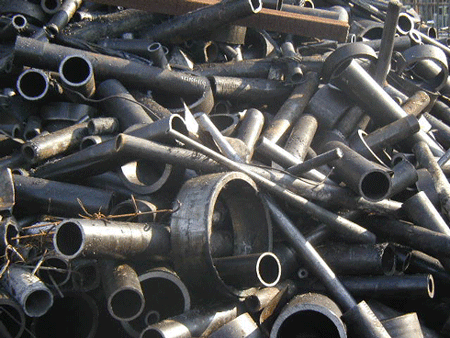
[ News ]Steel scrap: A world-traded commodity


To most, the word ‘scrap’ evokes visions of unwanted, discarded leftovers. However, to the steel industry, scrap represents a vital resource that enhances all aspects of steelmaking.
The recycling of scrap metal is an integral part of modern steelmaking, improving the industry's economic viability and reducing environmental impact. The recycling of steel scrap reduces the need for iron ore extraction, significantly reducing CO2 emissions, energy and water consumption and air pollution.
As a result of these efficiencies, steel scrap is increasingly being regarded as a raw material for manufacturing new products worldwide. Ferrous scrap – iron and steel – has become a globally traded commodity. The increased demand for steel scrap is reflected in recent trade statistics.
The United Nations Commodity Trade Statistics Database shows that the volume of global scrap exports increased from 9.3 million tonnes in 1990 to 106 million tonnes in 2011. Figures from the Bureau of International Recycling show that total world steel scrap use increased 7.6% in 2011 to reach 570 million tonnes.
The globalization of the ferrous scrap market, however, also places stresses on the system. The long lifespan of steel products means that the amount of steel available for recycling cannot keep up with the current world demand for new steel products. With steel, structures can last longer than 60 years and cars often last longer than 12 years; steel products can be seen as scrap-in-inventory – meaning that the steel will not be ready for recycling until the long life of the product comes to an end.
A positive aspect of steel is the ease of recycling when products finally do reach the end of their life. The ability to recover and collect old steel products for subsequent recycling is greatly enhanced by the inherent magnetic properties of steel; consequently, a large tonnage of steel becomes available for recycling every year.
Figures from the US Census Bureau and the US International Trade Commission demonstrate that the US is the world’s largest exporter of ferrous scrap – exporting nearly 23 million tonnes of iron and steel scrap in 2011. Globally, China, Taiwan, South Korea, India, Canada, and Turkey are the largest markets for exports of US steel scrap in that same period.
Ferrous scrap exports from the EU to third countries reached a record high in 2012. The 27 member states exported around 19.22 million tonnes of iron and steel wastes and scrap valued at €6.8 billion to countries outside the Union (extra-EU trade), according to preliminary figures released by the European Statistical Office, Eurostat. The export volume exceeded the 2011 amount of 18.81 million tonnes by 407,000 tonnes or 2.2%. The UK was by far the largest exporter of the EU-27, shipping nearly 5.2 million tonnes of ferrous scrap outside the EU. The most important destination country for EU ferrous scrap was Turkey. At 11.05 million tonnes and a value of €3.3bn, around 58% of all extra-EU ferrous scrap exports headed to this country (2011: 9.97 million tonnes, €3.1bn).
North America is also one of the largest consumers of its own steel scrap – recycling more than 70% of that scrap domestically, with mini-mills being the primary source of recycled steel. Mini-mills use electric arc furnaces, which melt scrap metal via the heat produced by an electric arc. US producers Nucor (one of the world's largest steel producers), as well as one of its competitors, Commercial Metals Company (CMC) use mini-mills exclusively. Since the electric arc furnace can be easily started and stopped on a regular basis, mini-mills can follow the market demand for their products easily, operating on 24 hour schedules when demand is high and cutting back production when sales are lower.
“This high level of scrap consumption is a reflection of the steel industry’s commitment to conserving energy and natural resources,” said Gregory Crawford, executive director of the Steel Recycling Institute in North America. “Scrap steel is used in everyday products, including packaging, appliances, automobiles and construction. Each year, more steel is recycled in North America than paper, aluminum, plastic and glass combined.”
This flow of scrap also faces challenges in the form of trade restrictions. The Organization for Economic Cooperation and Development (OECD) reported in 2012 that North American and European ferrous scrap is traded openly, but that about 19 percent of the scrap trade is burdened by various trade restrictions.
The 2012 OECD report noted that “waste and scrap exports are restricted in many parts of the world. Waste and scrap trade involving iron and steel and non-ferrous base metals (copper, aluminum, lead and zinc) tends to be more regulated than trade involving other metals.”
The OECD found that, in 2009, at least 19% of scrap of iron and steel, exported by a total of 34 countries, was subject to export restrictions. “Export restrictions dampen trade flows,” stated the report. “In fact, some exports actually will not take place due to the very fact that export restrictions are in place. Export activity would be higher if restrictions did not exist.”
The rationales that governments cite most frequently as motivating their use of the restrictions include safeguarding domestic supplies, controlling illegal exports, and protecting local industry. Non-automatic export licensing, export taxes and other export prohibitions were among the measures used to regulate the export of iron and steel scrap, according to the OECD.

[ Info ] Steel: Higher, Faster, Deeper, Longer!

Innovation in steel makes it possible.
From the deepest depths of the sea to the stars in the universe, steel allows humans to push the boundaries of the possible! Our latest infographic shows how innovation in steel has helped our civilization smash through new barriers, strengthen our lives, and hit new heights.

#lovesteel: Steel in the home

This news is originally published in World Steel Asssociation.

worldsteel launched the start of phase two of its #lovesteel campaign titled ‘Steel in ...’. The campaign will develop into a series of interesting facts and intriguing images of steel use across different industries and describes how steel enriches modern living and enables us to have a more sustainable lifestyle.
The starting theme is ‘Steel in the Home’. The first infographic ‘Home, Steel, Home’ launched on 8 July , shows the widespread use of steel in our home environment and illustrates the value and benefits it brings in four key areas; sustainability, cost, safety, and design. Through a detailed cross-section the infographic highlights where steel is used in each part of the house and how it helps to make your home more sustainable.
Two upcoming infographics will present key statistics of steel use in the construction sector and the amazing architectural styles made possible by steel in residential housing. The first of these infographics was launched on 20 July and is published below.


[ Wiki ]STAINLESS STEEL FINISHING OPTIONS

There are a number of stainless steel finishing options that alter more than just the appearance of the material. Whatever the intended use, choosing the right finish option is essential.
In projects when design is a primary consideration, an attractive finish will enhance the appeal of the end-product. For example, in architecture and the automotive industries, different finishes can be used to achieve a variety of visual effects. In retail products, particularly kitchen appliances, stainless steel No. 4 finish is one of the most popular finishes available.
The choice of surface finish is also important where fabrication processes will be applied. Rough surface finishes are appropriate when the steel will be ground prior to painting and gluing. Smooth surface finishes are better where the steel will be blended.
The choice of finish should always be clearly specified and properly defined by standard industry designations.

THE DEVELOPMENT OF THE SURFACE FINISH STANDARD

During the late 1970’s, British Steel scientists found that dull polished finishes on stainless steel showed a wide range of surface roughness. Further testing revealed that steel with high surface roughness was heavily damaged by the polishing operations, whereas steel with low surface roughness was relatively unscathed.
During the mid-1980’s dull polished finishes became widely used on projects such as high-profile architectural projects. However, it was soon discovered that some of these dull polished finishes had poor corrosion resistance, especially when exposed to seawater. Consequently a new surface finish description was introduced which remains in use to this day.
Three more common stainless steel finishing options are:
  1. No. 2B – Matte finish
  2. No. 4 – Brushed finish
  3. No.8 – Mirror finish

NO. 2B – MATTE FINISH

stainless steel finishing options - 2B
No. 2B – Matte Finish
No. 2B is the mill finish, meaning it has not been processed further. Matte finishes are dull in appearance and are not ideal for atheistic end uses. However, they’re a good choice where appearance is not important or when further finishing is intended. No. 2B Matte finishes are the least expensive of the stainless steel finishing options.
The finish is produced by ‘cold rolling’ stainless steel through special rolls or dies. The cold rolling produces a smoother, less pitted surface. Next it is softened and de-scaled in acid solution. The steel is given a final pass on polished rolls to further enhance its smoothness.
Common applications include:
  • Chemical plant equipment
  • Pharmaceutical equipment
  • Paper mill equipment
  • Laundry and dry cleaning
  • Refrigeration
  • Sewage equipment

NO. 4 – BRUSHED FINISH

stainless steel finishing options - no. 4
No. 4 Brushed Finish
The No. 4 Brushed finish can vary with different suppliers and even from batch to batch from the same supplier. The variations arise from differing manufacturing conditions, such as wearing of the abrasive belts used in these finishes. Some level of variation should be expected when ordering No. 4 Brushed finish. It can be helpful to request a sample of a few square inches to ensure the finish achieves the desired effect.
Brushing the stainless steel produces a distinctive look with a muted luster and a pattern of fine parallel lines. It has strong decorative appeal without being too reflective, as too much reflectiveness can be undesirable. For example, overly reflective stainless steel accents on a building could be blinding in bright sunlight. The drawbacks to this finish include reduced corrosion resistance, because the grooves of the finish are susceptible to rust.
The finish is created by sanding the stainless steel in one direction with a 120-180 grit belt, followed by softening with a 80-120 grit medium non-woven belt.
brushed stainless steel finishing options
Gateway Arch
Common applications include:
  • Jewelry and watches
  • Home appliances
  • Air conditioners
  • Water heaters
  • Architecture
  • Automotive design
The Gateway Arch in St Louis, Missouri is the world’s tallest arch and is clad in brushed stainless steel.
The DeLorean DMC-12 sports car, most famous for being featured in the Back to the Future films, is paneled in brushed stainless steel.

NO.8 – MIRROR FINISH

Mirror finishes are highly reflective and created by polishing the stainless steel. The polishing process enhances appearance and consistency, making cleaning easier. It also masks the after-effects of welding and hides surface damage.
No. 8 Mirror finish is created by mechanically treating the surface with a series of progressively finer abrasives. Alternatively a special rolling procedure is used which can simulate the appearance of mechanical abrasion. For this stage, it is essential to remove deep scratches as any surface defects will be very noticeable on the finished product. The final process involves buffing the surface for 5-10 minutes to create a mirror-like, highly reflective finish.
A benefit of No. 8 Mirror finishing is that it improves corrosion resistance. The polishing eradicates crevices where corrosive particles can lodge themselves.
Common applications include:
  • Mirrors
  • Ornamental trim
  • Clean rooms
  • Column covers
  • Wall panels
  • Reflectors

[ Wiki ] DIFFERENCE BETWEEN ANNEALING AND TEMPERING

HEAT TREATMENTS


Heat treatments are used to alter the physical and mechanical properties of metal without changing its shape. They are essential processes in metal manufacturing which increase desirable characteristic of metal, while allowing for further processing to take place.
Various heat treatment processes involve carefully controlled heating and cooling of metal. Steel, for example, is commonly heat treated for use in a variety of commercial applications.
Common objectives of heat treatment are to:
  • Increase strength
  • Increase hardness
  • Improve toughness
  • Improve machining
  • Improve formability
  • Increase ductility
  • Improve elasticity
How Heat Affects Metal
The cooling stage has different effects depending on the metal and process. When steel is cooled quickly it hardens, whereas the rapid cooling stage of solution annealing will soften aluminum.
While there are many types of heat treatment, two important types are annealing and tempering.

ANNEALING


Annealing involves heating steel to a specified temperature and then cooling at a very slow and controlled rate.
Annealing is commonly used to:
  • Soften a metal for cold working
  • Improve machinability
  • Enhance electrical conductivity
Annealing also restores ductility. During cold working, the metal can become hardened to the extent that any more work will result in cracking. By annealing the metal beforehand, cold working can take place without any risk of cracking, as annealing releases mechanical stresses produced during machining or grinding.
Annealing is used for steel, however, other metals including copper, aluminum and brass can be subject to a process called solution annealed.
Large ovens are used for annealing steel. The inside of the oven must be large enough to allow air to circulate around the metal. For large pieces, gas fired conveyor furnaces are used while car-bottom furnaces are more practical for smaller pieces of metal.
During the annealing process, the metal is heated to a specific temperature where recrystallization can occur. At this stage, any defects caused by deformation of the metal are repaired. The metal is held at that temperature for a fixed period, then cooled down to room temperature.
The cooling process must be done very slowly to produce a refined microstructure, thus maximizing softness. This is often done by immersing the hot steel in sand, ashes or other substances with low heat conductivity, or by switching off the oven and allowing the steel to cool with the furnace.

TEMPERING


Tempering is used to increase the toughness of iron alloys, particularly steel. Untempered steel is very hard but is too brittle for most applications. Tempering is commonly done after hardening to reduce excess hardness.
Tempering is used to alter:
  • Hardness
  • Ductility
  • Toughness
  • Strength
  • Structural stability
Tempering involves heating the metal to a precise temperature below the critical point, and is often done in air, vacuum or inert atmospheres.
The temperature is adjusted depending on the amount of hardness that needs to be reduced. While it varies depending on the metal type, generally, low temperatures will reduce brittleness while maintaining most of the hardness, while higher temperatures reduce hardness which increases elasticity and plasticity, but causes some yield and tensile strength to be lost.
It is essential to heat the metal gradually to avoid the steel being cracked. The metal is then held at this temperature for a fixed period. A rough guideline is one hour per inch of thickness. During this time the internal stresses in the metal are relieved. The metal is then cooled in still air.

Stainless Steel Sheet Laser Film

 Stainless Steel Sheet Laser Film
Usually it is better to use laser film if the stainless steel will be have laser cutting. Because
the laser film are good in viscosity and the glue on the film will not be thawing in high
temperature.
There are two brand of laser film, one is poli film, another is NOVACEL.


[ Wiki ]Frequently Asked Questions of Stainless Steel

These are some of the questions that we frequently get asked.

What Is Stainless Steel?
Stainless steel is an alloy of Iron with a minimum of 10.5% Chromium. Chromium produces a thin layer of oxide on the surface of the steel known as the'passive layer'. This prevents any further corrosion of the surface. Increasing the amount of Chromium gives an increased resistance to corrosion.
Stainless steel also contains varying amounts of Carbon, Silicon and Manganese. Other elements such as Nickel and Molybdenum may be added to impart other useful properties such as enhanced formability and increased corrosion resistance.
When was stainless steel discovered?
There is a widely held view that stainless steel was discovered in 1913 by Sheffield metallurgist Harry Brearley. He was experimenting with different types of steel for weapons and noticed that a 13% Chromium steel had not corroded after several months. However, the picture is much more complex than this.

What is stainless steel used for?


Stainless steels of various kinds are used in thousands of applications. The following gives a flavour of the full range:

Domestic – cutlery, sinks, saucepans, washing machine drums, microwave oven liners, razor blades

Architectural/Civil Engineering – cladding, handrails, door and window fittings, street furniture, structural sections, reinforcement bar, lighting columns, lintels, masonry supports

Transport – exhaust systems, car trim/grilles, road tankers, ship containers, ships chemical tankers, refuse vehicles

Chemical/Pharmaceutical – pressure vessels, process piping.

Oil and Gas – platform accommodation, cable trays, subsea pipelines.

Medical – Surgical instruments, surgical implants, MRI scanners.

Food and Drink – Catering equipment, brewing, distilling, food processing.

Water – Water and sewage treatment, water tubing, hot water tanks.

General – springs, fasteners (bolts, nuts and washers), wire.
Does stainless steel corrode?
Although stainless steel is much more resistant to corrosion than ordinary carbon or alloy steels, in some circumstances it can corrode. It is 'stain-less' not 'stain-impossible'. In normal atmospheric or water based environments, stainless steel will not corrode as demonstrated by domestic sink units, cutlery, saucepans and work-surfaces.
In more aggressive conditions, the basic types of stainless steel may corrode and a more highly alloyed stainless steel can be used. 

What forms of corrosion can occur in stainless steels?
The most common forms of corrosion in stainless steel are:
  1. Pitting corrosion - The passive layer on stainless steel can be attacked by certain chemical species. The chloride ion Cl- is the most common of these and is found in everyday materials such as salt and bleach. Pitting corrosion is avoided by making sure that stainless steel does not come into prolonged contact with harmful chemicals or by choosing a grade of steel which is more resistant to attack. The pitting corrosion resistance can be assessed using the Pitting Resistance Equivalent Number calculated from the alloy content.
  2. Crevice corrosion - Stainless steel requires a supply of oxygen to make sure that the passive layer can form on the surface. In very tight crevices, it is not always possible for the oxygen to gain access to the stainless steel surface thereby causing it to be vulnerable to attack. Crevice corrosion is avoided by sealing crevices with a flexible sealant or by using a more corrosion resistant grade.
  3. General corrosion - Normally, stainless steel does not corrode uniformly as do ordinary carbon and alloy steels. However, with some chemicals, notably acids, the passive layer may be attacked uniformly depending on concentration and temperature and the metal loss is distributed over the entire surface of the steel. Hydrochloric acid and sulphuric acid at some concentrations are particular aggressive towards stainless steel.
  4. Stress corrosion cracking (SCC) - This is a relatively rare form of corrosion which requires a very specific combination of tensile stress, temperature and corrosive species, often the chloride ion, for it to occur. Typical applications where SCC can occur are hot water tanks and swimming pools. Another form known as sulphide stress corrosion cracking (SSCC) is associated with hydrogen sulphide in oil and gas exploration and production.
  5. Intergranular corrosion - This is now quite a rare form of corrosion. If the Carbon level in the steel is too high, Chromium can combine with Carbon to form Chromium Carbide. This occurs at temperatures between about 450-850 deg C. This process is also called sensitisation and typically occurs during welding. The Chromium available to form the passive layer is effectively reduced and corrosion can occur. It is avoided by choosing a low carbon grade the so-called 'L' grades or by using a steel with Titanium or Niobium which preferentially combines with Carbon.
  6. Galvanic corrosion - If two dissimilar metals are in contact with each other and with an electrolyte e.g. water or other solution, it is possible for a galvanic cell to be set up. This is rather like a battery and can accelerate corrosion of the less 'noble' metal. It can avoided by separating the metals with a non-metallic insulator such as rubber.

How many types of stainless steel are there?


Stainless steel is usually divided into 5 types:
  1. Ferritic – These steels are based on Chromium with small amounts of Carbon usually less than 0.10%. These steels have a similar microstructure to carbon and low alloy steels. They are usually limited in use to relatively thin sections due to lack of toughness in welds. However, where welding is not required they offer a wide range of applications. They cannot be hardened by heat treatment. High Chromium steels with additions of Molybdenum can be used in quite aggressive conditions such as sea water. Ferritic steels are also chosen for their resistance to stress corrosion cracking. They are not as formable as austenitic stainless steels. They are magnetic.
  2. Austenitic - These steels are the most common. Their microstructure is derived from the addition of Nickel, Manganese and Nitrogen. It is the same structure as occurs in ordinary steels at much higher temperatures. This structure gives these steels their characteristic combination of weldability and formability. Corrosion resistance can be enhanced by adding Chromium, Molybdenum and Nitrogen. They cannot be hardened by heat treatment but have the useful property of being able to be work hardened to high strength levels whilst retaining a useful level of ductility and toughness. Standard austenitic steels are vulnerable to stress corrosion cracking. Higher nickel austenitic steels have increased resistance to stress corrosion cracking. They are nominally non-magnetic but usually exhibit some magnetic response depending on the composition and the work hardening of the steel.
  3. Martensitic - These steels are similar to ferritic steels in being based on Chromium but have higher Carbon levels up as high as 1%. This allows them to be hardened and tempered much like carbon and low-alloy steels. They are used where high strength and moderate corrosion resistance is required. They are more common in long products than in sheet and plate form. They have generally low weldability and formability. They are magnetic.
  4. Duplex - These steels have a microstructure which is approximately 50% ferritic and 50% austenitic. This gives them a higher strength than either ferritic or austenitic steels. They are resistant to stress corrosion cracking. So called “lean duplex” steels are formulated to have comparable corrosion resistance to standard austenitic steels but with enhanced strength and resistance to stress corrosion cracking. “Superduplex” steels have enhanced strength and resistance to all forms of corrosion compared to standard austenitic steels. They are weldable but need care in selection of welding consumables and heat input. They have moderate formability. They are magnetic but not so much as the ferritic, martensitic and PH grades due to the 50% austenitic phase.
  5. Precipitation hardening (PH) - These steels can develop very high strength by adding elements such as Copper, Niobium and Aluminium to the steel. With a suitable “aging” heat treatment, very fine particles form in the matrix of the steel which imparts strength. These steels can be machined to quite intricate shapes requiring good tolerances before the final aging treatment as there is minimal distortion from the final treatment. This is in contrast to conventional hardening and tempering in martensitic steels where distortion is more of a problem. Corrosion resistance is comparable to standard austenitic steels like 1.4301 (304). 

Is stainless steel non-magnetic?

It is commonly stated that “stainless steel is non-magnetic”. This is not strictly true and the real situation is rather more complicated. The degree of magnetic response or magnetic permeability is derived from the microstructure of the steel. A totally non-magnetic material has a relative magnetic permeability of 1. Austenitic structures are totally non-magnetic and so a 100% austenitic stainless steel would have a permeability of 1. In practice this is not achieved. There is always a small amount of ferrite and/or martensite in the steel and so permeability values are always above 1. Typical values for standard austenitic stainless steels can be in the order of 1.05 – 1.1. 
It is possible for the magnetic permeability of austenitic steels to be changed during processing. For example, cold work and welding are liable to increase the amount of martensite and ferrite respectively in the steel. A familiar example is in a stainless steel sink where the flat drainer has little magnetic response whereas the pressed bowl has a higher response due to the formation of martensite particularly in the corners.
In practical terms, austenitic stainless steels are used for “non-magnetic” applications, for example magnetic resonance imaging (MRI). In these cases, it is often necessary to agree a maximum magnetic permeability between customer and supplier. It can be as low as 1.004.

Can I use stainless steel at low temperatures?

Austenitic stainless steels are extensively used for service down to as low as liquid helium temperature (-269 deg C). This is largely due to the lack of a clearly defined transition from ductile to brittle fracture in impact toughness testing.
Toughness is measured by impacting a small sample with a swinging hammer. The distance which the hammer swings after impact is a measure of the toughness. The shorter the distance, the tougher the steel as the energy of the hammer is absorbed by the sample. Toughness is measured in Joules (J). Minimum values of toughness are specified for different applications. A value of 40 J is regarded as reasonable for most service conditions.
Steels with ferritic or martensitic structures show a sudden change from ductile (safe) to brittle (unsafe) fracture over a small temperature difference. Even the best of these steels show this behaviour at temperatures higher than -100 deg C and in many cases only just below zero.
In contrast austenitic steels only show a gradual fall in the impact toughness value and are still well above 100 J at -196 deg C. 
Another factor in affecting the choice of steel at low temperature is the ability to resist transformation from austenite to martensite.


Can I use stainless steel at high temperatures?


Various types of stainless steel are used across the whole temperature range from ambient to 1100 deg C. The choice of grade depends on several factors:
  1. Maximum temperature of operation
  2. Time at temperature, cyclic nature of process
  3. Type of atmosphere, oxidising , reducing, sulphidising, carburising.
  4. Strength requirement
In the European standards, a distinction is made between stainless steels and heat-resisting steels. However, this distinction is often blurred and it is useful to consider them as one range of steels.
Increasing amounts of Chromium and silicon impart greater oxidation resistance. Increasing amounts of Nickel impart greater carburisation resistance.


What is 'multiple certification'?


This is where a batch of steel meets more than one specification or grade. It is a way of allowing melting shops to produce stainless steel more efficiently by restricting the number of different types of steel. The chemical composition and mechanical properties of the steel can meet more than one grade within the same standard or across a number of standards. This also allows stockholders to minimise stock levels.
For example, it is common for 1.4401 and 1.4404 (316 and 316L) to be dual certified - that is the carbon content is less than 0.030%. Steel certified to both European and US standards is also common.

HOW IS STAINLESS STEEL MADE?

Stainless steel is known for excellent corrosion resistance. It is an integral part of modern life and is used in a range of applications, including heavy industry, architecture, automotive manufacture, surgery and dentistry.
Until the 1950s and 1960s, which saw the development of AOD (argon oxygen decarburization) and VOD (vacuum oxygen decarburization), the processes to produce stainless steel were slow and expensive. However, these two developments revolutionized stainless steelmaking and significantly decreased the raw material costs, increased productivity, and improved quality. This led to dramatic growth of steelmaking from the 1970s until the present.

HOW IS STAINLESS STEEL MADE?

Raw materials

Stainless steel is an iron alloy with added elements such as chromium, nickel, silicon, manganese, nitrogen and carbon. The properties of the final alloy can be fine-tuned by altering the amounts of the various elements.

The importance of chromium in making stainless steel

Chromium is essential for the production of stainless steel; in fact there’s no viable alternative. Chromium is a hard, corrosion-resistant transition element that gives stainless steel its corrosion resistance. In general, the higher the chromium content, the more corrosion-resistant the steel.

The manufacturing process

Melting
The raw materials are melted together in an electric arc furnace. It can take 8 to 12 hours of intense heat until the metal becomes molten.
Removal of carbon content
The next stage is to remove excess carbon. This is done by processing the molten metal in an AOD (Argon Oxygen Decarburization) converter. The converter reduces the carbon by injecting an oxygen-argon mixture. At this stage, further alloying elements like nickel and molybdenum can be added to the AOD converter.
Alternatively a VOD (Vacuum Oxygen Decarburization) converter can be used to when a very low carbon content is required.
Tuning
Most stainless steels have exacting quality requirements. The tuning process allows fine adjustments to the chemical composition. Tuning is when the steel is slowly stirred to remove unwanted elements and improve consistency, while maintaining the required composition within the temperature limits.
Forming
Now the molten steel is cast into forms. These forms can be blooms (rectangular shapes), billets (round orsquare shapes), slabs, rods or tubes.
Hot rolling
Hot rolling occurs at a temperature above the recrystallization temperature of the steel. The precise temperature depends on the desired stainless steel grade. The steel forms are heated and passed through high rolls. Blooms and billets are formed into bar and wire. Slabs are formed into plate, strip, and sheet.
Cold rolling
Cold rolling is used where extremely precise dimensions or an attractive finish are required. The process occurs below the recrystallization temperature of the steel. Cold rolling is carried out using small-diameter rolls and a series of supporting rolls. This process allows the production of wide sheets with improved surface finishes.
Annealing
Annealing is the process used to soften stainless steel, improve ductility, and refine grain structure. It is also used to relieve internal stresses in the metal caused by previous processing. During the annealing process the steel is heated and cooled under controlled conditions.
Descaling
The annealing process causes scale to form on the steel. These scales are commonly removed using pickling, which involves bathing the steel in nitric-hydrofluoric acid. Electrocleaning is an alternative method which uses an electric current to remove the scale.
Cutting
The stainless steel can now be cut to the desired size. Mechanical cutting is the most common method. The stainless steel can be straight sheared with guillotine knives, circle sheared using circular knives, sawed using high-speed blades, or blanked with punches and dies. Other methods include flame cutting, which uses a flame-fired torch powered with oxygen, propane, and iron powder, or Plasma Jet cutting which uses an ionized gas column in conjunction with an electric arc to cut the metal.
Finishing
Surface finish is important for stainless steel products, especially in applications where appearances are important. While most people are familiar with the look of stainless steel used for consumer products, there are actually a number of finishing options.
Grinding wheels or abrasive belts are commonly used to grind or polish the steel. Other methods include buffing with cloth wheels with abrasive particles, dry etching using sandblasting, and wet etching using acid solutions. The smooth surface provides better corrosion resistance.