THE KITCHEN SINK TAKES A LOT OF ABUSE. POTS AND PANS, DISHWARE AND SILVERWARE, ALONG WITH FOOD PREPARATION, ALL TAKE THEIR TOLL ON THE KITCHEN ESSENTIAL. AS THE CENTRAL FIXTURE IN THE KITCHEN, YOU WANT A SINK THAT CAN TAKE THE ABUSE AND STILL LOOK GOOD. ONE DURABLE CHOICE IS A STAINLESS STEEL SINK. BUT NOT ALL STAINLESS SINKS ARE CREATED EQUAL. TO EVALUATE A STAINLESS STEEL SINK, YOU NEED TO CONSIDER A FEW FACTORS IN ITS MAKEUP.
STEEL GAUGE
To ascertain the strength of the stainless steel, evaluate it based on its gauge. Stainless steel is a metal alloy used in a variety of applications, such as the construction of the Chrysler Building in New York. The thickness of stainless steel equates to its gauge, the number of layers that it takes to make 1 inch. For instance, 16-gauge stainless steel takes 16 layers of steel to make it an inch thick. The lower the gauge number, the thicker the steel, and the greater the sink can resist dents and scratches.
OXIDATION RESISTANCE
Oxidation leads to rust, but the chromium-to-nickel ratio in steel helps prevent it. So prior to purchase, check this ratio, as nickel gives the stainless steel strength and hardness, and chromium offers durability and shine. A typical chromium-to-nickel ratio uses 18 percent chromium and 10 percent nickel. It typically reads 18/10 on the sink's label.
FINISH TYPE
Stainless steel sinks come satin, polished, mirror or matte finishes. The type of finish you choose can be an asset or a liability in the kitchen. If you don't want to be constantly polishing the kitchen sink, avoid choosing a sink with a mirror or polish finish. These finishes show water spots and scratches. Instead, choose a sink with a matte or brushed finish that also provides resistance against scratches.
INSULATION
Some stainless steel sinks come without insulation. Without insulation, water heat escapes quickly, and the sounds are louder. Insulation helps to deaden the sound of water running in the kitchen. Check the type of insulation offered on the stainless steel sink. Foam insulation is of better quality and works more efficiently than sprayed-on insulation.
MOUNT TYPE AND SHAPE
Most kitchen sinks are available in differing mounting configurations. Some mount atop the counter and others underneath counters. Undermount units are best suited for solid surfaces such as stone or granite; they won't work with laminate materials. Choose a sink shape that matches your current sink or one that works well when remodeling.
BOWL DEPTH
Stainless steel sinks also come in multiple bowl depths. Some are shallow, while others offer a much deeper sink. Before buying your new stainless steel sink, verify it is deep enough to work with your cookware.
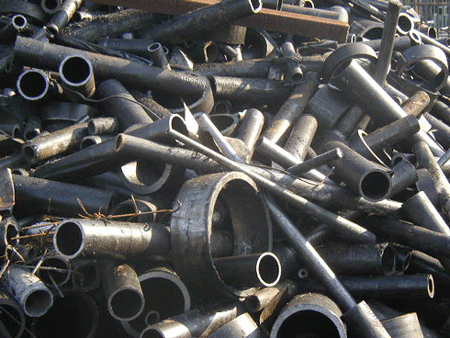
To most, the word ‘scrap’ evokes visions of unwanted, discarded leftovers. However, to the steel industry, scrap represents a vital resource that enhances all aspects of steelmaking.
The recycling of scrap metal is an integral part of modern steelmaking, improving the industry's economic viability and reducing environmental impact. The recycling of steel scrap reduces the need for iron ore extraction, significantly reducing CO2 emissions, energy and water consumption and air pollution.
As a result of these efficiencies, steel scrap is increasingly being regarded as a raw material for manufacturing new products worldwide. Ferrous scrap – iron and steel – has become a globally traded commodity. The increased demand for steel scrap is reflected in recent trade statistics.
The United Nations Commodity Trade Statistics Database shows that the volume of global scrap exports increased from 9.3 million tonnes in 1990 to 106 million tonnes in 2011. Figures from the Bureau of International Recycling show that total world steel scrap use increased 7.6% in 2011 to reach 570 million tonnes.
The globalization of the ferrous scrap market, however, also places stresses on the system. The long lifespan of steel products means that the amount of steel available for recycling cannot keep up with the current world demand for new steel products. With steel, structures can last longer than 60 years and cars often last longer than 12 years; steel products can be seen as scrap-in-inventory – meaning that the steel will not be ready for recycling until the long life of the product comes to an end.
A positive aspect of steel is the ease of recycling when products finally do reach the end of their life. The ability to recover and collect old steel products for subsequent recycling is greatly enhanced by the inherent magnetic properties of steel; consequently, a large tonnage of steel becomes available for recycling every year.
Figures from the US Census Bureau and the US International Trade Commission demonstrate that the US is the world’s largest exporter of ferrous scrap – exporting nearly 23 million tonnes of iron and steel scrap in 2011. Globally, China, Taiwan, South Korea, India, Canada, and Turkey are the largest markets for exports of US steel scrap in that same period.
Ferrous scrap exports from the EU to third countries reached a record high in 2012. The 27 member states exported around 19.22 million tonnes of iron and steel wastes and scrap valued at €6.8 billion to countries outside the Union (extra-EU trade), according to preliminary figures released by the European Statistical Office, Eurostat. The export volume exceeded the 2011 amount of 18.81 million tonnes by 407,000 tonnes or 2.2%. The UK was by far the largest exporter of the EU-27, shipping nearly 5.2 million tonnes of ferrous scrap outside the EU. The most important destination country for EU ferrous scrap was Turkey. At 11.05 million tonnes and a value of €3.3bn, around 58% of all extra-EU ferrous scrap exports headed to this country (2011: 9.97 million tonnes, €3.1bn).
North America is also one of the largest consumers of its own steel scrap – recycling more than 70% of that scrap domestically, with mini-mills being the primary source of recycled steel. Mini-mills use electric arc furnaces, which melt scrap metal via the heat produced by an electric arc. US producers Nucor (one of the world's largest steel producers), as well as one of its competitors, Commercial Metals Company (CMC) use mini-mills exclusively. Since the electric arc furnace can be easily started and stopped on a regular basis, mini-mills can follow the market demand for their products easily, operating on 24 hour schedules when demand is high and cutting back production when sales are lower.
“This high level of scrap consumption is a reflection of the steel industry’s commitment to conserving energy and natural resources,” said Gregory Crawford, executive director of the Steel Recycling Institute in North America. “Scrap steel is used in everyday products, including packaging, appliances, automobiles and construction. Each year, more steel is recycled in North America than paper, aluminum, plastic and glass combined.”
This flow of scrap also faces challenges in the form of trade restrictions. The Organization for Economic Cooperation and Development (OECD) reported in 2012 that North American and European ferrous scrap is traded openly, but that about 19 percent of the scrap trade is burdened by various trade restrictions.
The 2012 OECD report noted that “waste and scrap exports are restricted in many parts of the world. Waste and scrap trade involving iron and steel and non-ferrous base metals (copper, aluminum, lead and zinc) tends to be more regulated than trade involving other metals.”
The OECD found that, in 2009, at least 19% of scrap of iron and steel, exported by a total of 34 countries, was subject to export restrictions. “Export restrictions dampen trade flows,” stated the report. “In fact, some exports actually will not take place due to the very fact that export restrictions are in place. Export activity would be higher if restrictions did not exist.”
The rationales that governments cite most frequently as motivating their use of the restrictions include safeguarding domestic supplies, controlling illegal exports, and protecting local industry. Non-automatic export licensing, export taxes and other export prohibitions were among the measures used to regulate the export of iron and steel scrap, according to the OECD.
What surface finishes are available on stainless steels?
There are many different types of surface finish on stainless steel. Some of these originate from the mill but many are applied later during processing, for example polished, brushed, blasted, etched and coloured finishes.
The importance of surface finish in determining the corrosion resistance of the stainless steel surface cannot be overemphasised. A rough surface finish can effectively lower the corrosion resistance to that of a lower grade of stainless steel.
The European standards for stainless steels have attempted to define the most common surface finishes. However, due to the proprietary nature of many suppliers’ finishes, it is unlikely that complete standardisation is possible. This is a summary of the most common types for each product form
Common Surface Finishes for Flat Products from EN 10088-2 (for full list see Specifying finishes for stainless steel flat products (sheet and plate)
Surface Finish Code
Description
Mill finishes
1D
Hot rolled, heat treated, pickled. The most common hot rolled finish. A non reflective, rough surface. Not normally used for decorative applications
2B
Cold rolled, heat treated, pickled, pinch passed. The most common cold rolled mill finish. Dull grey slightly reflective finish. Can be used in this condition or frequently is the starting point for a wide range of polished finishes.
2D
Cold rolled, heat treated, pickled.
2H
Work hardened by rolling to give enhanced strength level. Various ranges of tensile or 0.2% proof strength are given in EN 10088-2 up to 1300 MPa and 1100 MPa respectively dependent on grade
2Q
Cold rolled hardened and tempered. Applies to martensitic steels which respond to this kind of heat treatment.
2R
Cold rolled and bright annealed, still commonly known as BA. A bright reflective finish. Can be used in this condition or as the starting point for polishing or other surface treatment processes e.g. colouring
In the following codes “1” refers to hot rolled being the starting point and “2” as cold rolled
Special Finishes
1G or 2G
Ground. Relatively coarse surface. Unidirectional. Grade of polishing grit or surface roughness can be specified
1J or 2J
Brushed or dull polished. Smoother than 1G/2G. Grade of polishing grit or surface roughness can be specified
1K or 2K
Satin polish. Similar to 1J/2J but with maximum specified Ra value of 0.5 micron. Usually achieved with SiC polishing belts. Alumina belts are strongly discouraged for this finish as this will have detrimental effect on corrosion resistance. Recommended for external architectural and coastal environments where bright polish (1P/2P) is not acceptable.
1P/2P
Bright polished. Non-directional, reflective. Can specify maximum surface roughness. The best surface for corrosion resistance.
2L
Coloured by chemical process to thicken the passive layer and produce interference colours. A wide range of colours is possible.
1M/2M
Patterned. One surface flat.
1S/2S
Surface coated e.g. with tin = Terne coating
2W
Corrugated. Similar to patterned but both surfaces are affected
Bead blasting
Not in EN 10088-2. Work being undertaken to more accurately define finishes.
How do I choose which stainless steel to use?
Most decisions about which steel to use are based on a combination of the following factors:
What is the corrosive environment? – Atmospheric, water, concentration of particular chemicals, chloride content, presence of acid.
What is the temperature of operation? – High temperatures usually accelerate corrosion rates and therefore indicate a higher grade. Low temperatures will require a tough austenitic steel.
What strength is required? – Higher strength can be obtained from the austenitic, duplex, martensitic and PH steels. Other processes such as welding and forming often influence which of these is most suitable. For example, high strength austenitic steels produced by work hardening would not be suitable where welding was necessary as the process would soften the steel.
What welding will be carried out? - Austenitic steels are generally more weldable than the other types. Ferritic steels are weldable in thin sections. Duplex steels require more care than austenitic steels but are now regarded as fully weldable. Martensitic and PH grades are less weldable.
What degree of forming is required to make the component? – Austenitic steels are the most formable of all the types being able to undergo a high degree of deep drawing or stretch forming. Generally, ferritic steels are not as formable but can still be capable of producing quite intricate shapes. Duplex, martensitic and PH grades are not particularly formable.
What product form is required? – Not all grades are available in all product forms and sizes, for example sheet, bar, tube. In general, the austenitic steels are available in all product forms over a wide range of dimensions. Ferritics are more likely to be in sheet form than bar. For martensitic steels, the reverse is true.
What are the customer’s expectations of the performance of the material? – This is an important consideration often missed in the selection process. Particularly, what are the aesthetic requirements as compared to the structural requirements? Design life is sometimes specified but is very difficult to guarantee.
There may also be special requirements such as non-magnetic properties to take into account.
It must also be borne in mind that steel type alone is not the only factor in material selection. Surface finish is at least as important in many applications, particularly where there is a strong aesthetic component. See Importance of Surface Finish.
Availability. There may be a perfectly correct technical choice of material which cannot be implemented because it is not available in the time required.
Cost. Sometimes the correct technical option is not finally chosen on cost grounds alone. However, it is important to assess cost on the correct basis. Many stainless steel applications are shown to be advantageous on a life cycle cost basis rather than initial cost. See Life Cycle Costing.
The final choice will almost certainly be in the hands of a specialist but their task can be helped by gathering as much information about the above factors. Missing information is sometimes the difference between a successful and unsuccessful application. See also General principles for selection of stainless steels